

Singapore is witnessing a bold and playful transformation of one of its most iconic leisure destinations. International contemporary artist Philip Colbert, often hailed as the “godson of Andy Warhol,” brings his largest outdoor presentation in Singapore to date with “Lobster Beach”, a semi-permanent public art takeover at Sentosa’s Tanjong Beach. Spanning land, sea, and skyline, this installation will remain in the city for six years, offering both locals and visitors a unique opportunity to experience contemporary art in an unexpected, immersive setting.
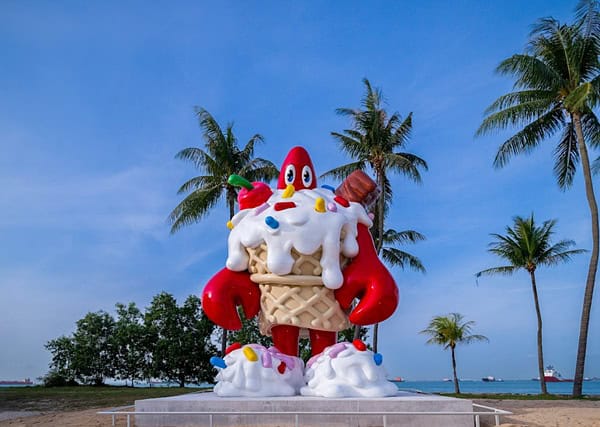
Set against the sun-kissed sands and crystal-clear waters of Tanjong Beach, Colbert’s project turns a familiar holiday hotspot into an open-air sculptural playground. With his signature Lobster persona, the artist introduces a series of monumental and inflatable works directly onto the shoreline, blending humour, pop culture, and art-historical references to create a vibrant, interactive environment. At the centre of this whimsical takeover is Lobster Ice Cream, an eight-metre-tall steel sculpture that dominates the beach, establishing a new iconic artistic landmark for the city.
Alongside the beach installation, Colbert’s public art initiative coincides with his solo exhibition, Temple of the Sunflower, at Whitestone Gallery Singapore. Together, the public art installation and gallery exhibition highlight Singapore’s growing status as a cultural capital in Asia, demonstrating how art can thrive in both intimate gallery settings and shared public spaces.
Transforming Tanjong Beach into a Pop-Art Playground
Colbert’s Lobster takeover extends beyond the monumental sculpture. Across the sand, visitors encounter a series of large Lobster inflatables such as Lobster Shark, Lobster Octopus, and Lobster Fish which reinterpret the artist’s alter ego in fantastical marine hybrid forms. Inspired by Claes Oldenburg’s soft sculptures and the playful energy of mascots, these works invite interaction, photography, and shared social experiences. The beach setting, traditionally associated with relaxation and recreation, encourages audiences to engage with contemporary art in a spontaneous and joyous way.
This ambitious project exemplifies Colbert’s commitment to art for all, blurring the boundaries between public leisure and high art. By placing large-scale, whimsical works directly within the everyday environment, he creates a surreal and democratic experience that is accessible to everyone.

Interview with Philip Colbert
Our team spoke to Philip Colbert, who shared more insights about Lobster Beach, his artistic vision, and Singapore’s place in the international art scene. Read on to find out more.
1) “Lobster Beach” is described as one of the most expansive artist-led public art interventions in Singapore’s history. What considerations guided your approach to creating work that exists simultaneously as art, landmark, and public leisure experience?
Philip Colbert: I have been lucky to visit Singapore many times and feel excited by the evolving contemporary art scene. To be able to be part of that with the largest public art takeover in the history of the city is an amazing opportunity.
The idea of having a giant lobster in disguise as a melting ice cream on Tanjong beach sounded perfect; the context couldn’t be more apt for the sculpture. The location at the end of the beach opposite the legendary Tanjong beach club was also perfect. I wanted the sculpture to be imposing and impactful as people first set eyes on it. Also, the lights at night really brings your attention to the sculpture.
2) Tanjong Beach is a space associated with relaxation and recreation rather than formal art consumption. How does situating your Lobster works in this context change the way you think audiences engage with contemporary art?
Philip Colbert: I love the energy of beach life. It’s so much more exciting than in a gallery. The beach activity adds energy to the environment and creates a very exciting space for art to exist alongside the fantasy of beach life. I loved seeing the artworks rising up above a volley ball game or someone doing back flips. A lovely sense of freedom exists on the beach.
3) Your Lobster persona has become both a visual signature and a conceptual device. How has this alter ego evolved in the transition from gallery settings to large-scale, semi-permanent public installations like Lobster Ice Cream?
Philip Colbert: I love how art in public spaces connects to people on a much more democratic level. The spirit of art for all. Also, it is surreal to see a giant lobster disguised as an ice-cream, towering 9M above you as you walk along a moonlit beach walk. Surrealism in life. Blurring the boundaries between art and reality.
4) The inflatable Lobster hybrids reference both pop culture mascots and art-historical precedents such as Claes Oldenburg. How consciously do you balance accessibility and intellectual depth when working in the public realm?
Philip Colbert: I love the spirit of accessibility in my work and to focus on universal symbols that I feel contain deep meaning for all. The power of common language to unlock profound poetry, and most importantly to also have humour – humour shakes the cage.
5) This project coincides with your solo exhibition at Whitestone Gallery and your presence at Art SG. How do these three platforms—public space, gallery, and art fair inform or challenge one another within your practice?
Philip Colbert: I think creating a city take over with multi locations and mediums widens the reach the work has in the city. For those who take interest in my sculptures they can devlve deeper into my world at the gallery show. I have been lucky that over the years my work has gained a lot of supporters in the city.
6) Singapore has positioned itself as a growing hub for public art and international cultural exchange. From your perspective, what distinguishes Singapore as a site for ambitious, long-term public art projects today?
Philip Colbert: I think the combination of lush green nature, contemporary skyscrapers and modern architecture is a defining aspect of the city. It’s a visually very distinctive city with a great relationship with nature. You can be on a beach right now and in 15 minutes be at the rooftop of Marina Bay Sands drinking cocktails, while overlooking the city skyline. I also love the energy of the people in the city. I always find them extremely friendly, generous and welcoming. Singapore’s energy is indeed something special.
Philip Colbert’s Lobster Beach transforms Tanjong Beach into a playful, immersive pop-art environment, demonstrating the power of public art to engage audiences in unexpected ways. By connecting monumental public installations with gallery exhibitions, Colbert invites Singaporeans and visitors alike to experience art that is humorous, interactive, and accessible to all. With its semi-permanent presence and bold visual language, Lobster Beach cements Colbert’s contribution to Singapore’s cultural landscape for years to come.
Event Details
Lobster Beach
Dates: 24 January – 15 February 2026
Location: Tanjong Beach, Sentosa Island, 20 Tanjong Beach Walk, Singapore 098942
Philip Colbert Solo Exhibition: Temple of the Sunflower
Dates: 24 January – 14 March 2026
Location: Whitestone Gallery Singapore, 39 Keppel Road #05-03/06, Tanjong Pagar Distripark, Singapore 089065
All images credit to Philip Colbert Studio