
A debit card is usually designed to be practical, something we carry in our wallets and use for everyday purchases. Singapore-based fintech Aleta is taking a different approach by turning the payment card into something designed to be collected, enjoyed and experienced.
Following the successful debut of its Cinnamoroll-themed Visa debit cards in June 2026, Aleta has introduced its limited-edition Hello Kitty Visa debit cards as the second instalment in a three-character Sanrio series. The Hello Kitty collection features 9,000 physical and virtual cards across three designs, with every physical card carrying its own unique serial number. A separate limited run of 300 metal Visa debit cards is also available through a lucky draw based on customers’ card spend points.
The three-part collection will be completed by Kuromi in November 2026. While the characters bring different personalities to the series, Aleta has designed the collection to appeal to both Sanrio fans and consumers looking for lifestyle benefits alongside everyday payment functionality. The latter is supported by the collection’s rewards and payment features, while the emphasis on collecting comes from the limited-edition, serialised card designs.
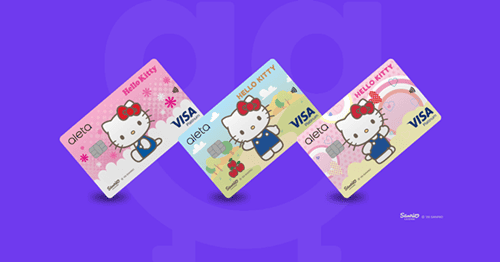
A Collectible Card with Lifestyle Rewards
The Hello Kitty edition comes with an expanded rewards catalogue featuring limited-edition Sanrio-themed merchandise, including cabin luggage, mahjong solitaire sets, grocery trolleys, yoga mats, dinnerware, ceramic teapots and glass cups, basketballs, cushions with baskets and bath towel sets.
Customers can also participate in Aleta’s Spin & Win rewards mechanic. Every qualifying spend of S$1 or more earns one instant Spin & Win entry, with every spin guaranteed to win a reward. The grand prize is a trip to Sanrio Puroland in Japan, available in December. Cardholders can also enjoy 10% off merchandise when paying with their Aleta Adventure card at Sanrio Shop outlets at Takashimaya and Chinatown.
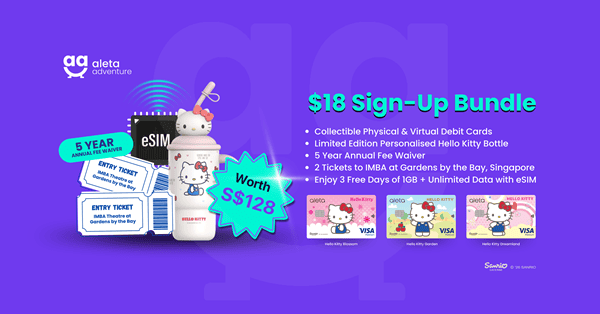
The Hello Kitty card costs S$18, with registration including a personalised Hello Kitty drink bottle, a five-year annual fee waiver, two IMBA Theatre tickets at Gardens by the Bay, and three free days of 1GB plus unlimited data with eSIM. Customers can also receive a 15% discount on the card through participating Sanrio Shop promotional codes when signing up through the Aleta Adventure app at the Takashimaya and Chinatown outlets.
Combining Collectibility with Everyday Payments
The Sanrio collection is not intended to be purely decorative. Aleta has also expanded the practical functionality available to cardholders.
Its Scan & Pay feature allows cardholders to scan local QR codes to make overseas payments at zero foreign exchange fee. For the Hello Kitty launch, the feature is being expanded beyond China to Vietnam and South Korea, with Japan planned to follow when Kuromi launches in November 2026.
The response to the first Cinnamoroll launch also helped shape the next stage of the collection. Aleta says the 9,000 Cinnamoroll-themed cards were fully applied for and approved within 45 days, sooner than expected. The company also reported that the cards were mostly sought after by young female customers in their 20s and 30s.
For the Hello Kitty edition, Aleta expects the character’s enduring appeal across generations to help drive interest. First introduced in 1974, Hello Kitty has become one of Sanrio’s most recognisable and globally beloved characters.
A Demonstration of Aleta’s Branded Card Capabilities
The Sanrio collaboration is also showcasing another area of Aleta’s business: its Visa BIN sponsorship programme.
Aleta is a Visa Principal Member and, through its BIN sponsorship business, sponsors or “lends” its Visa BIN to enterprises that want to issue their own branded Visa debit cards. According to Aleta, its plug-and-play technology solutions can reduce time-to-market to as fast as two weeks for Visa co-branded and white-label cards.
The Cinnamoroll and Hello Kitty launches therefore provide a consumer-facing example of how branded payment cards can combine card issuance with rewards and customer engagement. Aleta’s own BIN sponsorship materials also describe the Sanrio programme as a showcase of how its infrastructure can support co-branded Visa debit cards, serialised card production, rewards and cross-border payment features.
Behind the Hello Kitty Collection
What goes into creating a payment card that people want to collect? And how does a fintech company balance character appeal with practical payment features?
To explore the thinking behind Aleta’s three-character Sanrio series, the collaboration with Sanrio, the response to Cinnamoroll, Hello Kitty’s cross-generational appeal, the rewards programme and the future of branded payment cards, we spoke with Ryan Gwee, Founder and Group Chairman of Singapore-based fintech Aleta.
In the following interview, Ryan shares the thinking behind the collection and what Aleta hopes consumers will take away from the completed Sanrio series.
Interview with Ryan Gwee, Founder and Group Chairman of Singapore-based fintech Aleta.

1. Aleta launched Hello Kitty as the second character in a three-part series following Cinnamoroll and ahead of Kuromi. What was the thinking behind creating this three-character series, and why did Aleta choose these Sanrio characters for the collection?
Ryan Gwee: We wanted to build something that goes beyond a card that simply moves money — a series that people actually look forward to collecting. Sanrio characters have decades of goodwill behind them, and Cinnamoroll, Hello Kitty and Kuromi together give us a nice arc: Cinnamoroll is gentle and whimsical, Hello Kitty is the timeless icon that most families grew up with, and Kuromi brings a punkier, more playful edge for a younger, trendier crowd. Releasing them one at a time over several months also lets us build anticipation and give each character its own moment, rather than launching everything at once and losing that sense of occasion.
2. The Hello Kitty collection features three different card designs, with each physical card carrying its own unique serial number. Can you take us behind the design process and share how Aleta and Sanrio worked together to develop the three designs?
Ryan Gwee: This was a close, iterative collaboration with Sanrio rather than us simply licensing artwork off a shelf. We wanted the three Hello Kitty designs to feel distinct in mood — some more classic and elegant, others brighter and more playful — while still being instantly recognisable as part of the same family. Sanrio’s team reviewed every design closely to make sure each card stayed true to the character. Giving every physical card its own serial number was important to us too — it turns the card into something collectible in its own right, not just a payment tool, which is very much in the spirit of how fans already collect Sanrio merchandise.
3. The 9,000 Cinnamoroll-themed cards were fully applied for and approved within 45 days, sooner than Aleta expected. What did this response tell you about the demand for character-themed payment cards, and what did Aleta learn from the Cinnamoroll launch?
Ryan Gwee: Honestly, it told us we’d underestimated how much emotional pull a well-loved character has on a financial product. People don’t get excited about a debit card design very often, but Cinnamoroll changed that — customers were applying not just for everyday spending, but because they wanted that specific card in their wallet. From that launch we learned to plan for higher demand earlier, to have our operations and customer support ready for a faster ramp-up, and to make sure the rewards and app experience around the card were just as thoughtfully designed as the card itself, since that’s what keeps people engaged after the initial excitement of getting the card.
4. Aleta expects the Hello Kitty edition to see even stronger demand because Hello Kitty has a multi-generational following. What do you think gives Hello Kitty such broad appeal across different generations?
Ryan Gwee: Hello Kitty has managed something very few characters have — she means something different to almost every generation, yet the affection is the same. Parents who grew up with her in the 80s and 90s now see their own children discover her for the first time, so there’s a real intergenerational, shared-nostalgia element to it. She’s also simple and universal by design, which means she travels well across cultures and doesn’t feel dated. For us, that translates into a card that appeals not just to one segment, but to grandparents, parents and children alike — which is rare for any single product to achieve.
5. The Hello Kitty card comes with an expanded catalogue of limited-edition merchandise, Spin & Win rewards and a chance to win a trip to Sanrio Puroland. What was the thinking behind extending the collaboration beyond the physical card into these additional rewards and experiences?
Ryan Gwee: The card itself is the entry point, but we didn’t want the relationship with the customer to end there. Fans of these characters engage with them through merchandise, experiences and community — not just a single object — so we wanted the programme to reflect that. The Spin & Win mechanic keeps the experience fun and gives customers a reason to keep coming back, the merchandise catalogue lets them build out their collection, and the grand prize trip to Sanrio Puroland is the ultimate expression of that fandom. It turns what could have been a one-off purchase into an ongoing journey.
6. Aleta is expanding its scan & pay feature from China to Vietnam and South Korea, with Japan planned to follow when Kuromi launches in November. How does this expansion enhance the practical value of the Aleta Adventure card for customers, particularly those who travel?
Ryan Gwee: This is really where the card earns its keep beyond the collectible factor. Scan & pay lets our cardholders use local QR code systems to pay directly at zero foreign exchange fee, instead of relying on currency conversion or hunting for cash. Extending this from China into Vietnam and South Korea, and eventually Japan in time for the Kuromi launch, means a traveller can carry one card across several of Asia’s most popular travel destinations and pay the way locals do, without worrying about FX costs eating into their spending. For frequent travellers in the region, that’s a meaningful, everyday benefit sitting alongside the collectible appeal of the card.
7. The strong response to the Cinnamoroll launch also generated more enquiries about Aleta’s Visa BIN sponsorship programme. What opportunities does this create for businesses that want to develop their own branded Visa debit cards, and what does Aleta offer to help them do so?
Ryan Gwee: SMEs can build more brand loyalty among their customers when they use the company’s branded debit cards, with a reward system that benefits their customers and also aligns with the brand. More importantly, SMEs can get to know their customers better, as they get customer spending data insights.
The Cinnamoroll and Hello Kitty launches have really been a live demonstration of what’s possible under our BIN sponsorship programme – as Aleta has co-sponsored this card with Sanrio, and also developed this rewards infrastructure which can be a plug-and-play system for other cards. BIN stands for Bank Identification Number, which is the global standard for routing payments, with the first 6-8 digits identifying the issuing institution, network, card type, etc. SMEs can see firsthand how a well-executed branded card can drive genuine customer excitement rather than just being a piece of plastic. Through the programme, we handle the regulatory, compliance and card issuance infrastructure, so businesses — whether they’re travel platforms, retail brands or IP owners — can launch their own branded Visa cards without having to build out banking and card-issuing capabilities themselves. It significantly lowers the barrier for a business to bring a branded payment product to market quickly and compliantly.”
8. Looking ahead to the Kuromi launch in November, what would you like the completed three-character Sanrio series to represent for Aleta and for the consumers who have followed the collection?
Ryan Gwee: When Kuromi completes the series in November, I’d like it to represent proof that a payment card can be more than a functional necessity – it can be something people are genuinely fond of and proud to carry. For Aleta, I hope it establishes us as a fintech that understands both the infrastructure side of payments and the emotional, lifestyle side that makes a product memorable. And for the consumers who’ve followed the collection from Cinnamoroll through to Kuromi, I’d like them to look back on it as a journey they were part of from the start — not just three separate card launches, but one complete collection they helped bring to life.
All interview responses are attributed to Ryan Gwee, Founder and Group Chairman of Singapore-based fintech Aleta.
More Than a Payment Card
Aleta’s Hello Kitty collection demonstrates how financial products can be designed around more than transactions. By bringing together payment functionality, collectibility, rewards and travel-related benefits, the company is exploring a more lifestyle-oriented approach to the everyday debit card.
With Kuromi scheduled to complete the Sanrio series in November, the final chapter will provide another opportunity to see how consumers respond to a character with a distinctly different personality and aesthetic.
For Aleta, the larger ambition is to show that fintech can combine payment infrastructure with experiences and emotional connections, creating products that consumers may genuinely enjoy using and carrying.
Find Out More
Interested in the Aleta Sanrio Hello Kitty Visa debit cards and the Aleta Adventure experience? Please visit Aleta’s official website for more information about Aleta and its payment solutions.
Applications for the Aleta Sanrio Visa debit cards are made through the Aleta Adventure app. The Hello Kitty collection forms the second part of the three-character series, with Kuromi scheduled to follow in November 2026.
For Sanrio fans, collectors, frequent travellers and those interested in the evolving intersection of fintech and lifestyle, Aleta’s Sanrio series offers an interesting example of how a familiar everyday payment product can be reimagined.