

Enter Wonderland and Crack the Case
What happens when the very thing that makes Wonderland wonderful suddenly disappears?
Sight Lines Entertainment brings audiences into the curious and unpredictable world of Crack The Case: Wonderland, an immersive detective experience running from 9 October to 1 November 2026 at the Goodman Arts Centre Blackbox.
Set within a fully realised Wonderland, the production combines immersive theatre, non-linear storytelling, mystery, character interaction and clues that audiences can investigate as they navigate the space.
This time, the case takes audiences into a Wonderland in trouble. The Madness is gone, the tea is cold, and the Mad Hatter needs help. Audiences are invited to interrogate characters, investigate the crime scene, look for clues and work towards saving Wonderland.
Unlike conventional theatre, audiences are not simply seated and watching events unfold in a predetermined sequence. Instead, they are given opportunities to explore, interact and make choices about how they experience the world.
The production features Noah Yap as the Mad Hatter, Masturah Oli as the Queen of Hearts, Tan Rui Shan as the March Hare, Victoria Lam as the Caterpillar, and Zulfiqar Izzudin as the Cheshire Cat.
The creative team includes Derrick Chew as Producer/Lighting Designer, Krish Natarajan as Writer/Director, Russell Goh as Spatial Designer, Bennett Bay as Sound Designer, and Jessy Choo as Head of Production.
From Theatre to Immersive Storytelling
Sight Lines Entertainment has developed its approach to immersive storytelling over the years, moving from conventional theatre-making towards experiences where audiences can actively participate in the narrative.
For Crack The Case: Wonderland, that approach means giving audiences the freedom to explore the world, interact with characters and investigate clues rather than experiencing the story from a fixed seat.
To learn more about the evolution of Sight Lines Entertainment’s immersive work and the creative considerations behind this production, We spoke with Derrick Chew, Founder and Artistic Director of Sight Lines Entertainment.
Interview with Derrick Chew, Founder and Artistic Director of Sight Lines Entertainment

1) Sight Lines Entertainment has been creating theatre and immersive experiences for audiences in Singapore for many years. How has your approach to creating these experiences evolved over time, and what continues to drive your interest in immersive storytelling?
Derrick Chew: Sight Lines was founded in 2012 with a clear mission: to develop the audiences of tomorrow. What began as conventional theatre-making has evolved into something far more participatory — a collision of theatre, gaming, and interactive storytelling that places the audience at the centre of the narrative.
The shift didn’t happen overnight. Over the past fifteen years, we’ve moved from staging plays to creating experiences where the audience isn’t just watching — they’re investigating, exploring, and ultimately shaping what unfolds. The Crack the Case series, which launched in 2023, represents the fullest expression of that evolution so far, blending theatrical performance with escape-room mechanics and letting audiences roam freely through the world we’ve built.
And that is what our audience want. They don’t just want to sit down and watch something passively. They want to be in the driver’s seat – navigating and creating their own experience.
And that is exactly what continues to drive us. The belief that audiences in Singapore are hungry for something more than passive spectatorship. They want to be part of the story.
2) With Crack The Case: Wonderland, audiences are given the freedom to explore the world, follow different clues and interact with the characters rather than experiencing the story from a fixed seat. From a producer and artistic director’s perspective, what are the biggest creative and practical considerations involved in giving audiences that degree of freedom?
Derrick Chew: The single biggest consideration is this: you cannot write what a room is going to do. Creatively, that means the script can’t be a script in the traditional sense. It has to be a framework — a set of characters, relationships, secrets, and possibilities that performers can navigate fluidly. The cast has to know their characters so thoroughly that they can respond authentically to anything, whether it’s a question about the Queen of Hearts’ motivations or a child asking why the tea is cold.
Practically, it means designing a space that supports exploration without becoming chaotic. The Goodman Arts Centre Blackbox will be transformed into a fully realised Wonderland, with scenes happening in different corners, clues embedded throughout, and no fixed route. VIP ticket holders even get their own secret quest and reserved seat at the Hatter’s table. But for everyone else, the experience is deliberately non-linear — you might follow a scene, abandon it to chase a clue, and circle back later. That freedom is the point.
The trade-off is that no two performances are ever the same, which is both terrifying and exhilarating. From a producer’s perspective, you have to build in enough structure to guarantee quality and consistency, while leaving enough space for genuine spontaneity. That balance is the hardest part — and the most rewarding.
3) Crack The Case: Wonderland includes dedicated family sessions for children aged six and above, alongside sessions for adult audiences. How did the team approach creating an experience that can appeal to different age groups while keeping the mystery and immersive nature of the production engaging for everyone?
Derrick Chew: The solution was to program two distinct bands within the same production. The 10.30am and 2pm sessions are built for families, open to children aged six and above with an accompanying adult. The 4.45pm and 8pm sessions are designed for adult audiences who want to lean into the mystery and the drama.
But the case itself — the mystery, the clues, the culprit — doesn’t change between sessions. What changes is the room. Families tend to bring a different energy: children ask the unexpected questions, and parents often get swept up in the detective work alongside them. Adult sessions, by contrast, might see audiences digging deeper into character dynamics or interrogating suspects with more persistence.
We also created the Wonderland Children’s Workshop, a one-hour pre-show experience for kids aged six and up, featuring drama games, craft activities, and tea-party etiquette . It’s designed to help younger audiences warm up to the world and feel like they’re part of the story before they even step through the door.
The key principle is respect: we don’t talk down to younger audiences, and we don’t simplify the mystery for them. We trust that a six-year-old can follow a trail of curious clues and upside-down logic. What matters is that the experience works on multiple levels — a child might be thrilled by spotting the Cheshire Cat’s grin, while an adult is piecing together who stole the Madness and why.
4) Unlike conventional theatre, an immersive production cannot fully predict where audiences will go or how they will interact with the performers. How do you work with the creative and performance teams to prepare for that unpredictability while maintaining the quality and consistency of each performance?
Derrick Chew: Rehearsal for an immersive show looks nothing like rehearsal for a conventional one. It’s less about blocking and memorisation, and more about improvisation, character depth, and scenario training.
We run our actors through simulations of different audience behaviours — what to do when a child asks something unexpected, how to respond when an adult challenges a character’s alibi, how to keep the world alive even if a scene is momentarily interrupted. The performers need to know not just their own character, but the entire web of relationships and secrets in Wonderland. They need to know what can be revealed, what must be protected, and how to redirect attention without breaking immersion.
Noah Yap, who plays the Mad Hatter, has spoken about how the unpredictability is actually what drew him to the role. Unlike film or television, there’s no “cut” or “take two” — if a child asks the Hatter something unexpected, that becomes part of the show. That requires a specific kind of performer: someone who is fully present, deeply grounded in character, and genuinely excited by the unknown.
Consistency comes from the world itself. The characters are fixed. The rules of Wonderland are fixed. The mystery has a solution. What varies is how audiences navigate it. As long as the performers stay true to their characters and the world stays internally coherent, every session will feel complete — even if no two sessions are identical.
5) After more than a decade of developing theatre, educational programmes and immersive experiences, what have you learned about what audiences in Singapore are looking for from live entertainment, and how has that influenced the way Sight Lines creates its productions?
Derrick Chew: After more than a decade, the lesson is clear: Singapore audiences want to be participants, not mere spectators.
They want agency. They want to feel that their presence matters — that the experience would be different if they weren’t there. Whether it’s a family solving a mystery together, a group of friends racing to crack the case before the clock runs out, or an individual quietly following a clue that caught their eye, audiences are looking for something that rewards their curiosity and engagement.
We’ve also learned that the line between “theatre” and “game” has blurred for many audiences. They don’t care about the category label — they care about whether the experience is immersive, whether it’s well-crafted, and whether it makes them feel something. Our Crack The Case series has found a sweet spot between theatrical performance and interactive puzzle-solving, and that’s resonated strongly with Singaporeans looking for something different.
And finally: audiences here respond to local stories told with local talent. Wonderland reimagines a classic text through a local lens, performed by a Singaporean cast. That matters. There’s a real appetite for experiences that feel both globally inspired and distinctly homegrown.
6) Crack The Case: Wonderland has been described as the latest, and possibly final, edition of the immersive detective series. Without revealing anything about the mystery, what makes this chapter meaningful to you, and what would you hope audiences remember after they leave Wonderland?
Derrick Chew: Wonderland is meaningful because it brings together everything we’ve learnt across the Crack The Case series — the non-linear storytelling, the audience agency, the blend of theatre and game — into a world that is instantly recognisable and endlessly playable.
Wonderland is a world built on nonsense and curiosity, which makes it the perfect setting for an immersive detective story. The Mad Hatter’s tea party is already a scene of delightful chaos. What happens when the Madness itself is stolen? When the tea goes cold, the riddles go stale, and the characters lose their spark? The audience has to step in and save the very thing that makes Wonderland wonderful.
This is our biggest and most expansive world that we’ve built and we’ve ending our Crack the Case series with a bang. As the final chapter in this series, there’s also a certain poetry to ending with Wonderland. It’s a world where logic and madness coexist, where the rules are made to be questioned. That feels like a fitting note to end on.
Exploring Wonderland with Krish Natarajan
While Derrick Chew’s perspective provides insight into Sight Lines Entertainment’s wider evolution towards participatory storytelling, the production also presents a particular creative challenge for its writer and director: how do you construct a mystery when audiences themselves can influence the way they encounter the story?
Krish Natarajan, Writer and Director of Wonderland, shares how the team approached the familiar world of Wonderland, designed audience agency into the mystery and prepared performers to respond to spontaneous interactions.
Interview with Krish Natarajan, Writer and Director of Wonderland

1) Wonderland is a world that many audiences may already be familiar with, but Crack The Case: Wonderland places it within an original mystery involving the disappearance of the force that makes Wonderland what it is. What drew you to Wonderland as the setting for this immersive detective story?
Krish Natarajan: Not only is wonderland a familiar world with characters that parents and children can recognise, it’s a story that has been reinterpreted and reimagined many times over the years. That freedom allows us to have fun with the world and make our own rules and backstories for the characters to enrich this mystery. It has so much whimsy and colour, which is sure to inspire a good time.
2) Audiences do not experience the story in a fixed sequence. They can follow scenes, interact with characters and pursue clues in different parts of the world. As a writer and director, how did you structure the story so that audiences can make their own choices while still being able to piece together a satisfying mystery?
Krish Natarajan: To some extent there is a fixed sequence in which the story unfolds, but yes, they are given agency to explore the set and more importantly, ask the characters whatever they want! It was important to give audiences space to be able to move wherever they want and choose who they want to speak to. Based on the narrative they have carved for themselves, the onus will be on them to plan and structure their questions There might also be little secrets to keep your eyes and ears out for!
3) In conventional theatre, the writer and director have much greater control over what audiences see and when they see it. What changes in your writing and directing process when audiences themselves become active participants in deciding which parts of the story to discover?
Krish Natarajan: I surprisingly don’t think it is that different. Similar to a traditional play, the audience have to go through a journey where they learn about the characters, the relationships and their personalities and how that might affect the mystery at hand. The part that is unconventional perhaps, is the puzzle and game design, where we need to design physical clues around the space that relate to the dialogue and the mystery. Unlike a traditional show, the audience can get up close and personal with the set and the immersive spaces we have designed. Their interpretation of clues becomes a big factor in cracking the case – so there needs to be a sensitivity towards the audience’s potential journey and how the physical space becomes an active storyteller too.
4) The performers have to respond to audience interaction in real time, and younger audience members in particular may ask questions or react in unexpected ways. How did you build flexibility into the characters and performances to allow for these spontaneous moments without losing the thread of the story?
Krish Natarajan: So, there are curated moments where the audience are given the opportunity to interact. If they can interact throughout, it would be chaos! But what we do in the rehearsal room is an activity called Hot Seating, where each actor sits in a “hot seat”. There, everyone else will ask them questions – crazy ones and sensible ones. This prepares the actors to expect anything and through it, create a well of fiction that they can dip into during the show.
5) For a child experiencing immersive theatre for the first time, the experience can involve observing closely, talking to characters, following clues and making choices independently. What do you hope young audiences will take away from being active participants in the story rather than simply watching it?
Krish Natarajan: I think children often do not receive enough credit for their intelligence nor do we reward them enough for their curiosity. I really hope an experience like this can encourage playfulness and curiosity whilst trusting the children enough with the agency to explore what they please and play by their own rules.
6) At the heart of the story is the idea that something has been taken away from Wonderland, affecting the very spirit of the world. Without giving away the mystery, what does that idea represent to you, and what deeper thought or feeling would you like audiences to take away from the story?
Krish Natarajan: This is a difficult question to answer without giving the ending away. But without saying much, I hope audiences take away the importance of fun from the story – that laughter isn’t unproductive, chaos isn’t always scary and nonsense isn’t always rubbish!
A Wonderland Built Around Audience Participation
At its heart, Crack The Case: Wonderland invites audiences to experience theatre differently. Rather than simply following a predetermined route, participants can explore the environment, interact with characters and look for clues while piecing together the mystery.
The official Sight Lines Entertainment website describes the experience as a non-linear journey through Wonderland, where audiences can choose whether to follow scenes or explore the world for clues. The experience lasts approximately 1 hour 30 minutes.
For families, the designated 10.30am and 2pm sessions are family-friendly, while the 4.45pm and 8pm sessions are suitable for adults.
With Wonderland itself becoming part of the storytelling, the production offers an experience where curiosity, observation, interaction and decision-making all have a role to play.
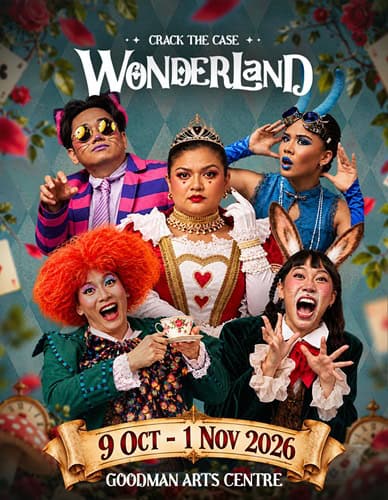
Crack The Case: Wonderland – Event Details
Event: Crack The Case: Wonderland
Dates: 9 October – 1 November 2026
Venue: Blk M, Goodman Arts Centre Blackbox
Address: 90 Goodman Road, Singapore
Show Timings
- Friday: 8pm
- Saturday: 10.30am, 2pm, 4.45pm, 8pm
- Sunday: 10.30am, 2pm, 4.45pm
Session Information
- 10.30am & 2pm: Family-friendly
- 4.45pm & 8pm: Suitable for Adults
- Duration: Approximately 1 hour 30 minutes
Cast
- Noah Yap as Mad Hatter
- Masturah Oli as Queen of Hearts
- Tan Rui Shan as March Hare
- Victoria Lam as Caterpillar
- Zulfiqar Izzudin as Cheshire Cat
Creative Team
- Producer/Lighting Designer: Derrick Chew
- Writer/Director: Krish Natarajan
- Spatial Designer: Russell Goh
- Sound Designer: Bennett Bay
- Head of Production: Jessy Choo
Ticket Prices
- Standard: $88
- VIP: $128
The experience is SG Culture Pass eligible.
The VIP experience includes an exclusive private tour of Wonderland before the experience, priority entry, exclusive clues and a secret quest, a reserved table at the Mad Hatter’s table, and a private photo opportunity with the cast.
Opening Weekend Special
Enjoy 20% off Standard tickets when purchasing two or more tickets for Opening Weekend, from 9–11 October 2026.
A 10% discount is also available for a group of four on Standard tickets.
For group or corporate bookings of 10 or more tickets, enquiries can be made through Sight Lines Entertainment.
With its combination of immersive theatre, interactive storytelling, mystery-solving and a familiar Wonderland setting, Crack The Case: Wonderland gives audiences the opportunity to become active participants in the story rather than simply watching from the sidelines.
Through our interviews with Derrick Chew and Krish Natarajan, we gain insight into the creative thinking behind an experience where the audience’s curiosity and choices become part of the journey.
From Sight Lines Entertainment’s evolution towards participatory storytelling to the detailed work involved in creating a Wonderland where performers must be ready for the unexpected, the production demonstrates how theatre can extend beyond the traditional stage and seating arrangement.
Ready to step into Wonderland, investigate the mystery and crack the case?
Visit Sight Lines Entertainment’s official website for the latest ticketing information and booking details.