
For parents whose children have secured a Primary 1 place for 2027, one major part of the journey is now behind them.
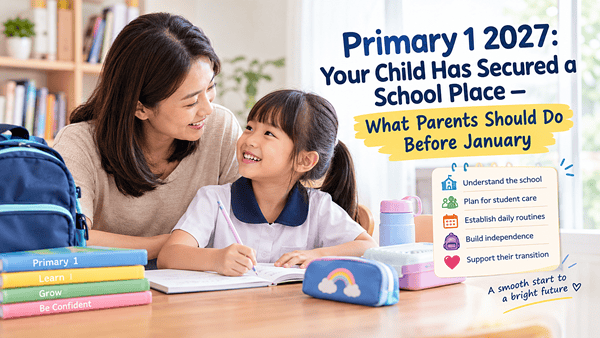
After months of thinking about schools and going through the Primary 1 registration process, the focus can now shift from choosing a school to getting ready for the transition into primary school.
Starting Primary 1 is a big milestone for children and parents alike. There are new routines to get used to, more responsibility for children and, for some families, practical arrangements such as Student Care and transport to work out.
The Ministry of Education (MOE) itself provides post-registration guidance for parents, including information on reporting to school, school-based Student Care Centres and the transition to primary school.
So, with January 2027 approaching, what can parents do now to help their children get ready?
Get Familiar With Your Child’s New School
Once your child’s school place has been confirmed, start paying attention to information from the school.
Check the school’s official website and any communications sent directly to parents. Schools will provide their own information about arrangements such as reporting, orientation activities, school items and other preparations, so it is important to follow the instructions from your child’s school rather than relying on information from another school.
It can also help to keep a simple calendar or checklist of important dates and things you need to prepare.
You do not have to get everything done immediately. Taking things one step at a time can make the transition feel much more manageable.
MOE’s current P1 Registration Portal has an “After results – Get ready for primary school” section, which directs parents to information on reporting to school, school-based Student Care Centres and the transition to primary school.
Think About What Happens After School
For working parents, one of the practical questions to consider is what happens after the school day ends.
This is where Student Care may become an important consideration.
MOE specifically includes school-based Student Care Centres (SCCs) among the areas parents can look into after registering their child for Primary 1.
If your family is considering Student Care, check with your child’s school about the options available and find out how the centre operates.
Depending on the centre, parents may want to ask about:
- Whether Primary 1 children can enrol
- How and when applications are made
- Operating arrangements
- What happens after school
- Homework or study support
- Meals and daily arrangements
- School holiday arrangements
- Fees and any available financial assistance
- Whether places are limited
The arrangements can differ between centres, so parents should check directly with the relevant school or Student Care Centre for the latest information.
And if your family does not need Student Care, there is no need to arrange it simply because your child is starting Primary 1. The right arrangement will depend on your family’s needs and circumstances.
Work Out the Daily Routine Before January
A primary school routine can feel quite different from preschool.
Instead of waiting until the first week of school to work everything out, think through a typical school day with your family.
What time will your child need to wake up?
How will your child get to school?
Who will accompany them?
What happens when school finishes?
Will they go home, attend Student Care or go somewhere else?
Who will collect them?
Thinking through these questions early can help parents identify practical issues while there is still time to make adjustments.
It can also help children become familiar with the idea of having a more structured school-day routine.
Help Your Child Become More Independent
Starting Primary 1 does not mean that children suddenly need to manage everything by themselves.
However, being familiar with simple everyday tasks can help children feel more comfortable taking responsibility for their own belongings and routines.
Parents can gradually give children opportunities to practise things such as:
- Packing and unpacking their school bag
- Looking after their water bottle
- Putting their belongings away
- Opening their own food containers
- Using the toilet independently
- Keeping track of personal belongings
- Following simple instructions
- Asking an adult for help when they need it
These do not have to become formal lessons.
For example, instead of automatically packing everything into your child’s bag, you could ask them to help check what they need.
The aim is not for your child to do everything perfectly. It is to give them opportunities to become more confident with everyday responsibilities.
Talk Through Everyday School Situations
Some situations that seem very ordinary to adults can feel unfamiliar to a child starting Primary 1.
Parents can talk through some of these situations casually before school begins.
You could ask:
“What would you do if you couldn’t find your classroom?”
“Who could you ask if you needed help?”
“What would you do if you needed to use the toilet during school?”
“What do you think you might do during recess?”
The purpose is not to make children worry about everything that could happen.
Instead, these conversations can reassure them that if they are unsure about something, they can ask a teacher or another appropriate adult for help.
Practise Recess and Mealtimes
Recess can be another new experience for children entering Primary 1.
If your child will be buying food at school, you can talk about what to expect and, where appropriate, practise simple skills such as handling money and making a purchase.
If your child will be bringing food from home, let them practise opening their lunch box, containers and water bottle independently.
You can also talk about simple habits such as keeping their belongings together, drinking water and cleaning up after eating.
There is no need to turn this into a complicated exercise. A little practice at home can make unfamiliar tasks feel more familiar.
Establish a Comfortable Morning and Bedtime Routine
Primary 1 mornings may become more structured, so it can be useful to establish a comfortable family routine before January.
Families can gradually work towards a schedule that gives everyone enough time to wake up, get ready, have breakfast and leave home without unnecessary rushing.
The same applies to bedtime.
If your child currently stays up quite late, gradually adjusting the family routine may make the transition to earlier school mornings easier.
There is no single bedtime that applies to every child. Parents should consider their child’s individual needs and make sure they are getting sufficient rest.
The goal is simply to avoid having the entire family’s schedule change suddenly when school begins.
Don’t Make Primary 1 Preparation All About Academics
It is understandable that parents may wonder whether their child knows enough before entering Primary 1.
But getting ready for primary school does not have to mean trying to complete as much academic work as possible before January.
MOE has removed weighted assessments and examinations for Primary 1 and Primary 2 since 2019, as part of its efforts to reduce assessment load and support children’s holistic development.
That does not mean learning is unimportant.
Instead, parents can also use the months before Primary 1 to encourage everyday learning habits.
Reading together, talking about things your child notices, encouraging questions, practising simple numeracy through everyday activities and allowing children to explore their interests can all be meaningful ways to prepare for school.
It is also useful to help children practise listening, communicating, following instructions and asking for help.
Preparing for Primary 1 is therefore about more than academic knowledge.
Talk About Primary School in a Positive Way
Some children will be excited about starting Primary 1.
Others may feel nervous.
Both reactions can happen when a child is preparing for a major change.
Your child may be leaving familiar preschool teachers and friends and entering a new environment. They may wonder whether they will make friends, find their classroom or know what to do during recess.
Instead of simply saying, “Don’t worry”, give your child opportunities to talk about what they are thinking.
You can talk about the things they may look forward to, such as meeting new classmates, learning new things, having recess and getting to know their teachers.
At the same time, let them know that it is okay to feel nervous.
A child does not have to feel completely confident before the first day. Becoming comfortable with a new environment takes time.
Let Your Child Take Part in the Preparation
Preparing for Primary 1 does not have to be something parents do entirely on their child’s behalf.
Where appropriate, let your child participate.
They can help organise some of their school items, practise packing their bag and talk about what they are looking forward to.
You can also involve them in conversations about their journey to school and what their school day might look like.
These small opportunities can make the upcoming change feel more familiar and give children a sense that they are part of the preparation.
Plan the Journey to School
Another practical matter to think about before January is how your child will travel to and from school.
If you will be accompanying your child, consider how long the journey takes and how it fits into your morning routine.
If your child will eventually travel more independently, make sure the arrangement is appropriate for their age and circumstances, and practise the route together where necessary.
A trial run closer to the start of the school year can also help the family understand how much time is actually needed in the morning.
It is better to discover that a journey takes longer than expected before the first day of school.
Prepare Without Trying to Make Everything Perfect
There can be a lot of pressure surrounding a child’s first year of primary school.
Parents may wonder whether their child is sufficiently prepared, whether they will make friends or whether they will manage the new routine.
But children do not need to know everything before their first day.
They will gradually learn how their new school works and become familiar with their surroundings.
What parents can do is give them opportunities to practise practical skills, build confidence and understand that it is okay to ask for help.
A Simple Primary 1 Preparation Checklist
With a few months before January, it can help to break the preparation into smaller steps.
September to October
- Keep track of information from your child’s school
- Check the school’s official website and parent communications
- Look out for information about reporting and orientation when provided by the school
- Consider whether your family needs Student Care
- Check Student Care arrangements directly with the school or centre
- Think through your child’s transport and after-school arrangements
October to November
- Give your child opportunities to practise everyday independence
- Talk about what primary school may be like
- Practise simple situations such as asking an adult for help
- Let your child practise opening food containers and managing personal belongings
- Work towards a comfortable weekday routine
November to December
- Check the school’s instructions about uniforms, books and other required items
- Label belongings where appropriate
- Practise packing and unpacking the school bag
- Practise the journey to school if useful
- Gradually adjust the family’s morning and bedtime routine if necessary
- Continue talking positively about starting Primary 1
Before the First Day
- Make sure you have followed the school’s instructions
- Have your child’s school items ready
- Check the morning routine
- Make sure your child knows who they can approach for help
- Reassure your child rather than adding unnecessary pressure
The exact timing will vary from family to family and according to the information provided by each school.
Starting Primary 1 Is a Big Step — But You Don’t Have to Rush It
Once a child has secured a Primary 1 place, the focus naturally changes.
It is no longer about finding a school. It is about helping your child prepare to become part of a new school community.
The coming months are a good opportunity to sort out practical matters such as Student Care and transport, while also giving your child opportunities to practise independence and become familiar with what primary school may be like.
Preparation does not have to be stressful.
You do not need to turn every day between now and January into a P1 training session.
A conversation here, a little practice there and gradually building familiar routines can be enough.
And when the first day finally arrives, your child may still feel a little nervous — and that is perfectly okay.
Starting Primary 1 is a new beginning. Give your child the space to learn, adjust, make friends and grow into this new chapter at their own pace.